
Professional Services
·
July 25, 2026
Project Management Career Path: Roles, Salary & PMP
The project management career path spans entry roles, PMP certification specs, median wages, and executive progression tiers.

Discover the most in-demand product manager skills for 2026, including AI, technical, and soft skills with resume examples to get more interviews.

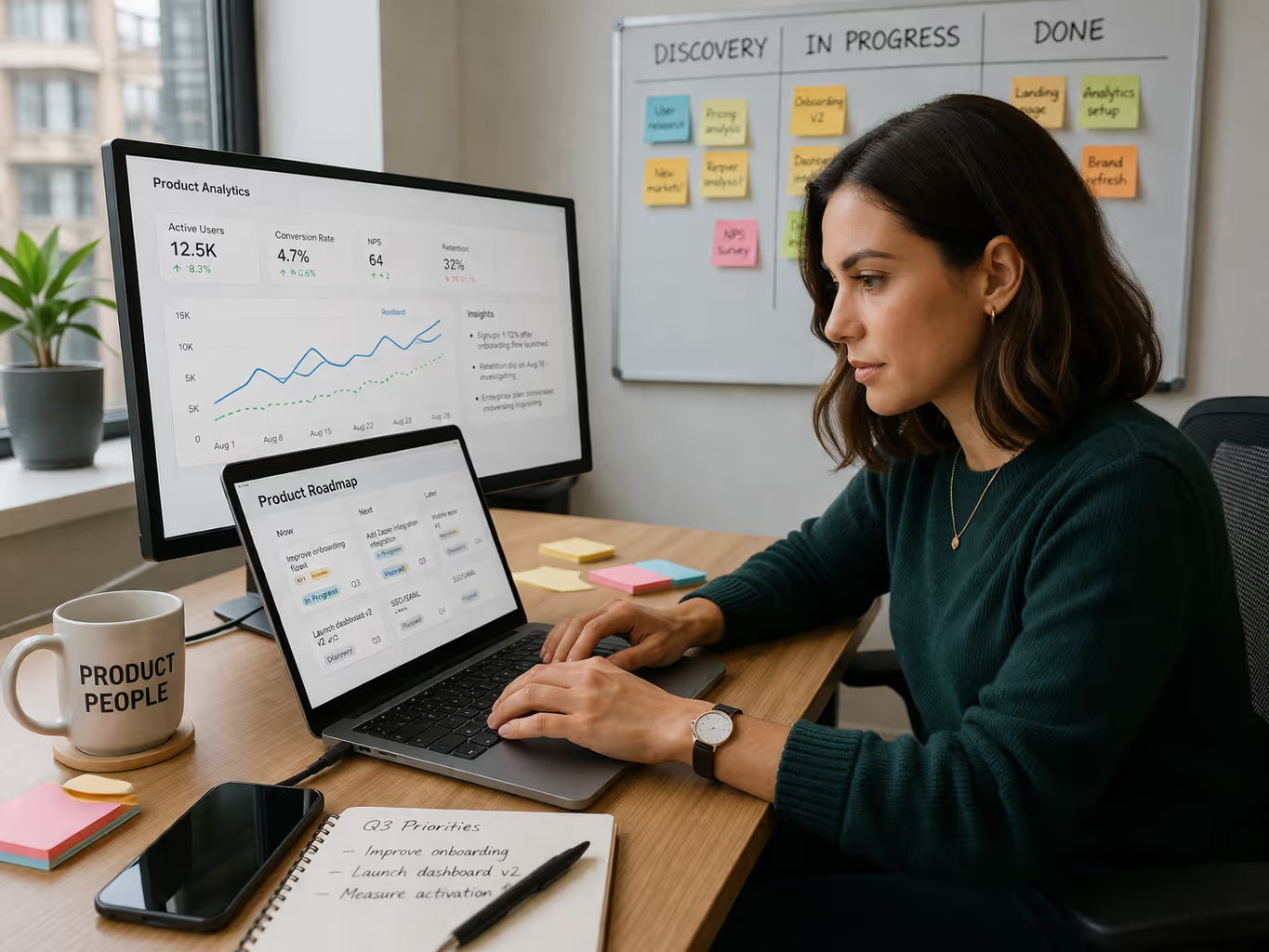
According to LinkedIn's Skills on the Rise 2026 report, AI Literacy, Cross-Functional Collaboration, and Go-to-Market Strategy are among the fastest-growing skills that hiring teams are actively screening for — and Product Managers appear as one of the most common job titles across multiple categories. Yet hiring managers consistently report that fewer than 1 in 5 applicants demonstrate the right combination of these skills. Knowing which product manager skills matter in 2026, and how to show them on your resume, can be the difference between rejection and an interview.
This guide breaks down the top hard skills, soft skills, and emerging AI capabilities hiring teams are screening for right now, with concrete resume examples you can adapt immediately.
The PM role has never been static, but the pace of change accelerated sharply after 2023. Three forces reshaped what employers expect: the normalization of AI tools in product workflows, the consolidation of roles at many companies (meaning PMs now own more surface area), and the rise of outcome-based hiring, where teams screen for measurable impact over job titles.
The result is a new baseline. A PM who excelled in 2021 by writing clear PRDs and running sprints may now be considered underprepared if they cannot interpret a cohort analysis, prompt an AI assistant effectively, or tie feature decisions to revenue metrics.
Understanding this context matters before you update your resume. Skills don't exist in a vacuum — they signal a level of operating sophistication to the hiring team reviewing your application.
Hard skills are the technical and analytical capabilities that can be demonstrated, tested, or verified. These are what ATS systems scan for first, and what hiring managers probe in early-round interviews. Use LandTheJob - our tool to create an ATS-friendly product manager resume.
Every PM job description in 2026 lists some variation of "data-driven decision making." What this actually means: you need to be comfortable pulling data, forming a hypothesis, and presenting a recommendation without waiting for a data analyst to do it for you.
Key capabilities include working with tools like Amplitude, Mixpanel, or Looker, writing basic SQL queries to pull product data, and translating metrics (DAU, retention, conversion, LTV) into product decisions.
Resume example (before):"Worked with data team to analyze user behavior."
Resume example (after):"Wrote SQL queries in Looker to analyze 90-day retention cohorts; identified a 22% drop-off at onboarding step 3, leading to a redesign that improved D30 retention by 14%."
Hiring teams want to see that you can prioritize ruthlessly and connect feature work to business outcomes. Familiarity with frameworks like RICE, MoSCoW, and Jobs to Be Done (JTBD) signals strategic thinking. More importantly, your resume should show that your roadmap decisions led somewhere.
You don't need to code. You do need to understand system architecture well enough to have credible conversations with engineers, recognize technical debt implications, and write specifications that don't require three rounds of clarification. Experience with REST APIs, webhooks, and agile tooling like Jira or Linear consistently appears in job descriptions for mid-to-senior PM roles.
AI has moved from a differentiator to a baseline expectation in the 2026 hiring market. According to a 2024 McKinsey survey, over 65% of organizations reported that they had integrated AI into at least one core product workflow — and PMs are expected to own or influence many of those workflows.
AI skills for product managers fall into three categories:
On your resume, AI skills should be contextual, not decorative. "Familiar with AI tools" adds nothing. "Used Claude to synthesize 400+ customer support tickets weekly, reducing discovery time by 60%" demonstrates impact.
Soft skills are harder to fake in an interview and harder to demonstrate on a resume — which is exactly why strong candidates find ways to show them through evidence rather than assertion.
PMs rarely have direct reports but routinely need buy-in from engineering, design, sales, legal, and executives. The ability to align stakeholders, navigate competing priorities, and communicate trade-offs clearly is consistently cited in PM job descriptions as a top requirement.
On your resume: show outcomes that required cross-functional coordination. "Launched X feature in partnership with 4 teams across engineering, legal, and marketing" is more credible than "strong cross-functional communicator."
The best PMs in 2026 are still the ones who talk to customers regularly and bring those insights back into the product process. Demonstrate familiarity with user interviews, usability testing, and continuous discovery practices. Teresa Torres' Continuous Discovery Habits framework has become a reference point for many hiring teams at product-led growth companies.
Senior PMs are explicitly evaluated on how they make decisions with incomplete information. Junior PMs should demonstrate they can operate within defined constraints. Both should show examples of trade-offs made and the reasoning behind them.
Technical Product Managers (TPMs) operate at the intersection of product and engineering and are hired into roles that require deeper system-level understanding. If you're targeting a TPM role, your PM skills list for 2026 should include:
TPM roles typically appear at larger tech companies or in B2B SaaS environments where the product is technically complex. Compensation benchmarks from Levels.fyi consistently show TPMs earning 15–30% more than generalist PMs at equivalent levels, reflecting the premium on technical depth.
Knowing which skills matter is only half the equation. How you present them to both ATS systems and human reviewers determines whether your resume converts to an interview.
A few practical rules:
See our guide on how to optimize a product manager resume for ATS.
Different seniority levels carry different skill expectations. Mismatching your positioning to the role is one of the most common reasons qualified candidates get screened out early.
Junior PM (0–2 years)
Mid-Level PM (3–5 years)
Senior / Principal PM (6+ years)
For professionals transitioning from engineering, business analysis, or project management, the fastest path to a PM role typically involves emphasizing transferable skills (technical fluency, stakeholder management, delivery execution) while building visible evidence of customer-facing product thinking through side projects, portfolio work, or internal transitions.
Read our guide on product manager resume summary examples.
The highest-signal skills in 2026 combine data fluency, AI tool proficiency, and strong stakeholder communication. Hiring managers consistently prioritize candidates who can move from customer insight to measurable product decision independently. Technical skills like SQL and API familiarity are increasingly expected even for non-technical PM roles, particularly at mid-stage and later-stage companies.
List skills in a dedicated section using terminology that mirrors the job description. Avoid vague labels like "strategic thinker." Instead, pair each key skill with a bullet point in your experience section that demonstrates it with a concrete outcome. ATS systems match keywords; human reviewers evaluate evidence of impact. You need both.
PMs should be able to use AI tools operationally to accelerate research, writing, and analysis. More advanced expectations include writing specs for AI-powered features, defining success metrics for ML models, and evaluating model outputs for reliability. At a minimum, comfort with LLM-based tools like Claude or ChatGPT in daily workflow is now a baseline expectation at most tech companies.
Hard skills are specific, teachable capabilities — SQL, roadmap tools, A/B testing, API knowledge. Soft skills are behavioral and interpersonal — prioritization under ambiguity, stakeholder influence, customer empathy. Both are evaluated in interviews. Hard skills often determine whether your resume gets through ATS screening; soft skills determine whether you get the offer. Neither set is optional at the mid-to-senior level.
No. Most hiring managers care far more about demonstrated product thinking and relevant experience than credentials. That said, certifications from programs like Reforge, Pragmatic Institute, or Product School can signal commitment and fill credibility gaps for career changers. An MBA from a target school can accelerate entry into certain companies or industries but is not a requirement for the majority of PM roles.
The product manager skills that move resumes to the top of the pile in 2026 are a specific combination: data fluency, AI tool proficiency, technical literacy, and the soft skills to drive alignment across teams without formal authority. The candidates who get hired aren't necessarily the most experienced — they're the ones who demonstrate these skills through evidence, not assertion.
Audit your resume against the skills outlined in this guide, update your bullets to lead with outcomes, and tailor your language to match each job description. That single habit — concrete evidence over vague claims — will increase your interview conversion rate more than any other change you make.
Start tailoring your product manager resume for specific job descriptions.